
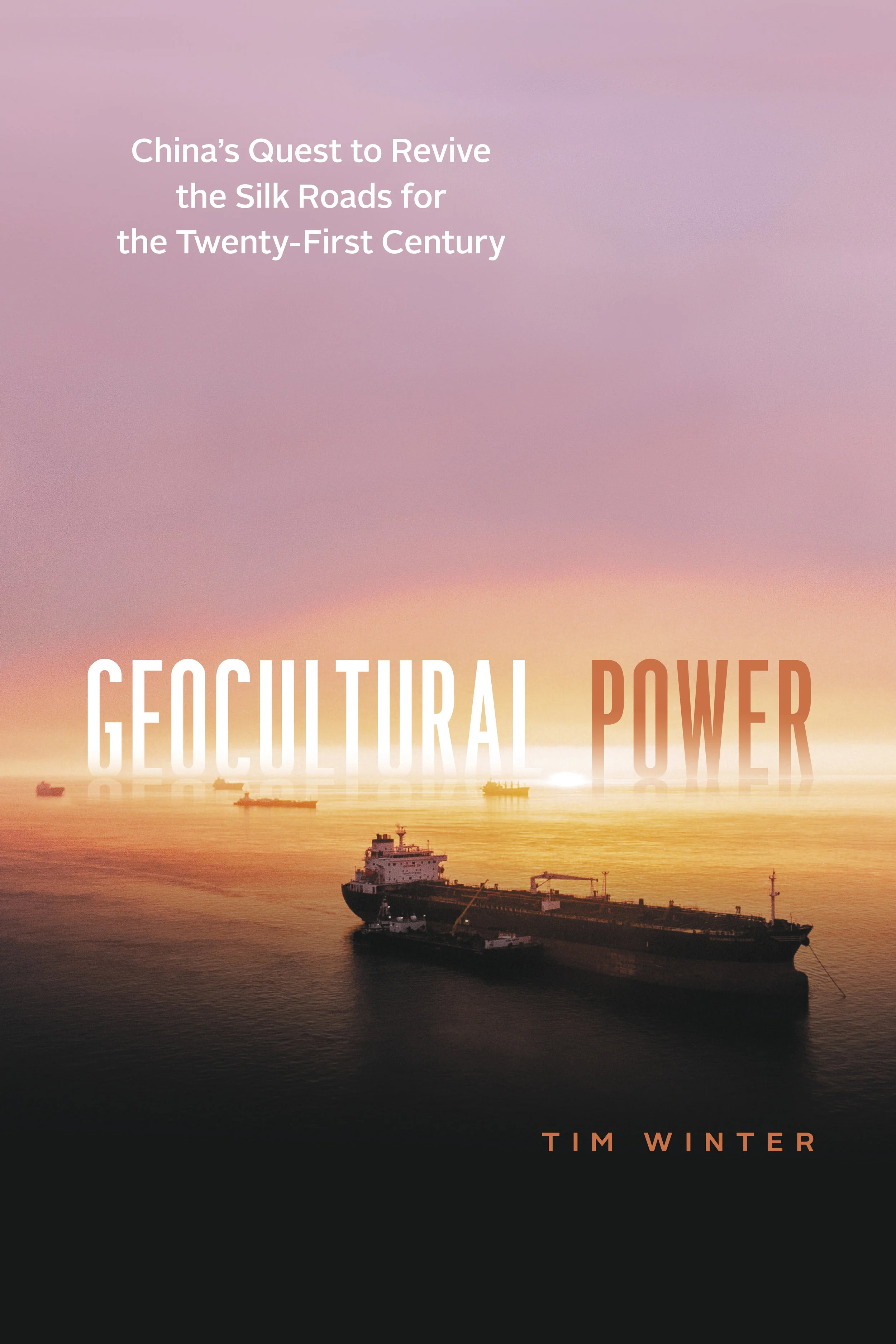
Geocultural Power
China's Quest to Revive the Silk Roads for the Twenty-First Century
Tim Winter
China's Belt and Road Initiative aims to connect continents and integrate Eurasia through collaborations spanning trade and infrastructure, culture and finance. Launched in 2013, it incorporates more than seventy countries and two-thirds of the world's population. But what does it mean to "revive" the Silk Roads for the twenty-first century?
Until now Belt and Road has been discussed as a geopolitical and geoeconomic project. This book introduces geocultural power to the analysis of international affairs.
Tim Winter highlights how Belt and Road bundles geopolitical ambition and infrastructure with carefully curated histories to produce a grand narrative of transcontinental connectivity: past, present and future. As Iran, Greece, Sri Lanka, Kenya, Malaysia and others mobilize the Silk Roads to find diplomatic and cultural connection, China becomes the new author of Eurasian history and the architect of the bridge between East and West. In a diplomatic dance of forgetting, episodes of violence and bloodshed are left behind for a language of shared heritage that crosses borders in ways that further an increasingly networked China-driven economy.

This book forms part of an exciting Silk Road series from University of Chicago Press.
Available Now
Amazon US
Amazon UK
Amazon Aus /CA /FR /DE
““In this fascinating account of the Silk Roads story, Winter argues that objects and histories are more potent than corridors of politics in weaving far-flung peoples and places into networks of cooperation. He views the contemporary Belt and Road Initiative as a quintessential Chinese assemblage of infrastructure and culture, of trade and diplomacy, of hard and soft power that aims to configure a geocultural topography beyond China’s borders. This is a sophisticated exploration of how China envisions and exercises its power abroad.””
““Winter has produced a unique and deeply insightful view of the Chinese Belt and Road initiative. Focusing on heritage culture along these routes, he reveals the tangible weave of Silk Road imaginaries with the geopolitics of Chinese infrastructural investments. It is worth following the extent to which this new arc of heritage culture can realize its cosmopolitan possibilities.””
““Winter provides a lucid, subtle, and meticulous account of the manifold ways in which heritage and history are invoked and deployed in the exercise of both novel and familiar forms of geopolitical power. The notion of heritage diplomacy provides a new and important conceptual framing which helps to shine a light on often neglected aspects of the politics of the past—showing how we might uncover the operations of power outside of conventional analyses of conflict and contention between and across the relations of citizens and nation-states. This important book breaks new ground in helping us to understand current transformations in the politics of heritage-and the accompanying transformation of forms of power-in the current era of ‘open’ borders, mass mobility, international trade, and geopolitical ‘cooperation’.””
Other Recent Articles by Tim Winter
-
The Geocultural Heritage of the Silk Roads - International Journal of Heritage Studies
-
Silk Roads and Cultural Routes - e-flux Architecture
-
Geocultural Power: China’s Belt and Road Initiative - Geopolitics Journal
-
Silk Road Diplomacy: Geopolitics and histories of connectivity - International Journal of Cultural Policy